How to Take Notes Effectively When Reading Textbook
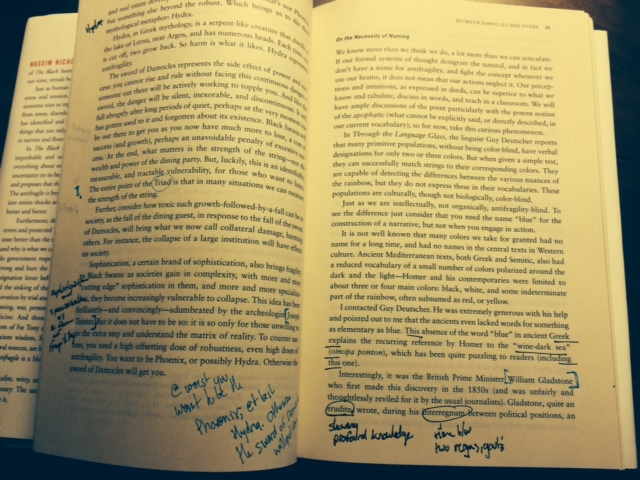
There are 3 steps to effectively taking notes while reading:
- At the end of each chapter write a few bullet points that summarize what you've read and make it personal if you tin — that is, apply it to something in your life. Besides, notation any unanswered questions. When yous're done the book, put it down for a week.
- Pick upward the book once again and go through all your notes. Most of these volition exist garbage merely in that location will exist lots you lot want to think. Write the expert stuff on the inside encompass of the book along with a page number.
- (Optional) Copy out the excerpts by hand or accept a movie of them to pop into Evernote. Tag accordingly.
***
I've been asked to how to have notes while reading a lot. Often what people are actually getting at is how tin I meliorate focus, retain, and use what I'm reading. And taking notes while reading tin supercharge all of these things if you practise it correct. Even so, when we're taught how to read read, we're not allowed to write in books. So nosotros never actually learn a system for taking notes that nosotros can employ equally adults.
The beginning step to taking notes is to figure out why you are taking notes. If you lot're studying for an exam your notes are going to look dissimilar than if you're reading for entertainment. The way y'all accept notes depends on the reason you're taking notes.
Learning something new every bit an adult is a function of consuming information (what you lot read and how you read), the data you retain, and your power to put what you lot learned into practise (recognize patterns). For this, I use a simple iii-step note-taking process that scales up to 150 books a twelvemonth.
Similar almost everything in life, there is no magical respond that fits everyone. Yous'll have to practice a bit of trial and error and take what works for you.
Taking Notes While Reading
Step I.The first thing I do when I pick upwards a book is read the preface, the table of contents, and the inside jacket. Often, I'll glance over the alphabetize too. This doesn't take long and ofttimes saves me time, equally a lot of books do not brand it past this filter. Maybe it doesn't contain the data I'yard trying to gain. If it seems crappy, I'll flip to a few random pages to verify.
This filter is a class of systematic skimming. This isn't my term, Mortimer Adler, a guy who literally wrote the book on reading, came upward with it. Adler says at that place are four levels of reading. I tend to blend inspectional reading and analytical reading together for most books.
This manner, when I commencement reading a book, I have an thought what it's well-nigh, the chief argument, and some of the terminology involved. I know where the author is going to take me and the wide strokes of how they will bring me forth. That's very useful information.
While reading, I take notes. I circle words I need to expect up. I star points that I think are critical to the statement. I underline anything that strikes me as interesting. I annotate similar a madman in the margins. I try to tease out assumptions, etc.
Essentially, I'1000 trying to engage in a conversation with the author. Peradventure my questions volition be answered on the next page or in the adjacent chapter. Maybe I'll need to notice another book to answer them. Who knows. Simply I write them down.
At the end of each chapter, I write a few bullet points that summarize what I've but read. When I'm done, I write a cursory summary of the entire book and and then I exercise something few other people do. I permit the book age.
I put the book on my desk and I won't bear on it for anywhere from a few days to a calendar week. This is very important.
Pace two.
When I selection the book up once again, I re-read every scribble, underline, and comment I've made (assuming I can still read my writing). Sometimes I can't.
I'yard not the same person I was the get-go time I read the volume, 2 things have inverse: (1) I've read the unabridged book and (2) I've had a chance to slumber on what may take seemed earth-shattering at the fourth dimension but now but seems meh.
If something yet strikes my interest, I write a note in the showtime few pages of the book, in my ain words, on the topic. Oftentimes this is a summary but increasingly it's ways to apply the knowledge. I index this to the page number in the volume.
Sometimes, and this depends on the volume, I'll create a sort of mental summary of the volume'southward principal arguments and gaps. Sometimes I'll cross-link points with other books.
Stride 3 (optional but highly effective).
Await a few days. Then go through the book and re-create out excerpts by hand and put them into your repository or commonplace volume. I utilise these notes to connect and synthesize ideas as I read.
To aid recall, connect the ideas to something you already have in your heed. Is information technology a continuation of the idea? Does it supplant an idea? Is information technology the same idea in a dissimilar discipline? I add these connections to my notes and percolate them in my mind. Often I turn out to be mistaken but that's the procedure.
Most of the time, yous go to see the ideas on Farnam Street. You can see how I connect and contextualize ideas, linking them beyond disciplines. I find writing most the ideas actually helps me develop my understanding.
Even if you don't share your thoughts with millions of people you lot can practise the same matter with Evernote, which is searchable, easy to use, and free. Personally, I practice not use technology every bit a substitute for the not-technological approach mentioned above but rather every bit a compliment.
I rarely listen to books but if you lot are listening to a volume, create a new note for that book and type in notes as you are listening. I know a few people that do not take notes as they are listening because they listen in the car on the mode to piece of work. They find that sitting down right away when they get to piece of work and typing up notes is an constructive way to better recall although the notes are less accurate.
If you liked this commodity, you'll honey our helpful guide to reading better.
Source: https://fs.blog/taking-notes-while-reading/
0 Response to "How to Take Notes Effectively When Reading Textbook"
Post a Comment