what happens to soil when rainforest is cut down
The wettest rainforest in the continental United States had gone up in flames and the smoke was so thick, and then blanketing, that you could see it miles away. Deep in Washington'south Olympic National Park, the aptly named Paradise Fire, undaunted by the dampness of it all, was eating the forest live and destroying an ecological Eden. In this season of drought across the Westward, there have been far bigger blazes just none quite so symbolic or offering quite such grim news. It isn't the size of the fire (though it is the largest in the park's history), nor its intensity. It's something else entirely — the fact that it shouldn't take been burning at all. When burn down can consume a rainforest in a relatively cool climate, you know the Globe is get-go to burn.
And here'due south the thing: The Olympic Peninsula is my home. Its destruction is my personal nightmare and I couldn't stay away.
Smoke gets in my eyes
"What a bummer! Tin can't even see Mount Olympus," a disappointed tourist exclaimed from the Hurricane Ridge visitor heart. Nevertheless pointing his camera at the hazy mountain-scape, he added that "on a sunny day like this" he would ordinarily take gotten a "articulate shot of the range." Indeed, on a good day, that vantage point guarantees you lot a postcard-perfect view of the Olympic Mountains and their glaciers, making Hurricane Ridge the most visited location in the park, with the Hoh rainforest coming in a close second. And a lot of people have taken photos there. With its more than 3 million almanac visitors, the park barely trails its two more famous western cousins, Yosemite and Yellowstone, on the tourist circuit.
Days of rain had come up the weekend before, soaking the rainforest without staunching the Paradise Burn. The wetness did, however, help create those massive clouds of fume that wrecked the view miles away on that blazing hot Sunday, July 19. Though no fire was visible from the company center — it was the old-growth rainforest of the Queets River Valley on the other side of Mount Olympus that was called-for — massive plumes of fume were ascension from the Elwha River and Long Creek valleys.
By then, I felt equally if fume had become my companion. I had first encountered it on some other hot, sunny Dominicus two weeks before.
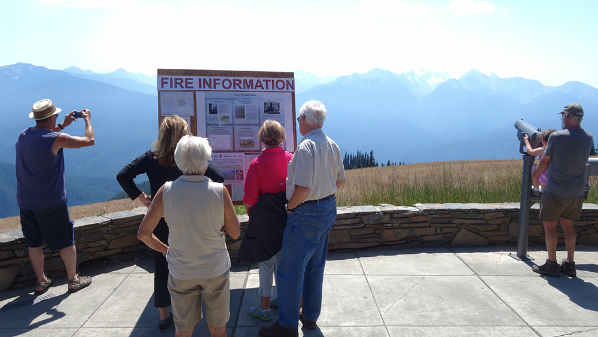
Burn down Data Message Board and Smoke from Burn down, Hurricane Ridge Visitor Center, Olympic National Park, July 19, 2015. Subhankar Banerjee
On July five, I had gone to Hurricane Ridge with Finis Dunaway, historian of environmental visual culture and author of Seeing Greenish: The Use and Corruption of American Environmental Images. As this countryside is 2nd nature to me, I felt the daze and sadness the moment we piled out of the auto. In a flavour when the meadows and hills should have been lush dark-green and carpeted by wildflowers, they were rusty brown and os-dry.
Ordinarily, fifty-fifty when such meadows are even so covered in snowfall, glacier lilies withal poke through. Avalanche lilies burst into riotous bloom as soon as the snow melts, followed past lupines, paintbrushes, tiger lilies, and the Sitka columbines, just to begin a listing. Those meadows with their chorus of colors are a wonder to photograph, but the flowers likewise provide much needed nutrition to birds and animals, including the endemic Olympic marmots that prefer, as the National Park Service puts it, "fresh, tender, flowering plants such every bit lupine and glacier lilies."
Snow normally lingers on these subalpine meadows until the end of June or early on July, but last winter and jump were "annihilation merely typical," as the summer issue of the park's quarterly newspaper, the Bugler, pointed out. January and Feb temperatures at the Hurricane Ridge station were "over 6 degrees Fahrenheit warmer than boilerplate."
Past late February, "less than 3 percent of normal" snowpack remained on the Olympic Mountains and the meadows, unremarkably still covered by more than six feet of snowfall, "were bare." As the Bugler also noted, recent data and scientific projections suggest that "this warming tendency with less snowpack is something the Pacific Northwest should become used to … What does this mean for summer wildflowers, common cold-water loving salmon, and myriad animals that depend on a flush of summer vegetation watered by melting snow?" The answer, unfortunately, isn't complicated: Information technology spells disaster for the ecology of the park.
Move on to the rainforest and the news is no less grim. This January, it got 14.07 inches of precipitation, which is 26 percent less than normal; February was 17 percent less; March was about normal; and April was off by 23 percent. Worse yet, what atmospheric precipitation at that place was mostly fell as pelting, non snow, and the culprit was those way-higher-than-average winter temperatures. And so the drought that already had much of the Due west Coast in its grip arrived in the rainforest. In May, precipitation fell to 75 pct less than normal and in June it was a staggering 96 percent less than normal, historic lows for those months. The forest floor stale up, every bit did the moss and lichens that hang in profusion from the trees, creating kindling galore and priming the wood for potential ignition by lightning.
That day, I was intent on showing Finis the spot along the Hurricane Hill trail where, in 1997, I had taken a picture of a black-tailed deer. That photo proved a turning signal in my life, winning the Slide of the Year honor from the Boeing photography club and leading me somewhen to surrender the security of a corporate career and start a conservation project in Alaska's Arctic National Wildlife Refuge.
As information technology happened, it wouldn't be a day for nostalgia or for seeing much of anything. On reaching Hurricane Loma, we found that the Olympic Mountains were obscured by fume from the Paradise Fire. Meanwhile, looking north toward the Strait of Juan de Fuca in the Salish Bounding main, all that we could see was an amber-lit deep haze. More fume, in other words, coming from more than than seventy wildfires called-for in British Columbia, Canada. As I write this, there are 14 agile wildfires in Washington and 5 in Oregon, while British Columbia recently registered 185 of them.
Then if y'all happen to live in the drought-stricken Southwest and are dreaming of relocating to the absurd, moist Pacific Northwest, think again. On the Olympic Peninsula, it's brume to the horizon and the worst drought since 1895.
A rainforest in a national park
For visitors to the Olympic Peninsula, it seems obvious that a temperate rainforest — itself a kind of natural wonder — should be in a national park. As information technology happens, getting it included proved to be one of the most drawn-out battles in American conservation history, which makes seeing information technology destroyed all the more bitter.
Two centuries agone, expanses of coastal temperate rainforests stretched from northern California to southern Alaska. Today, simply near iv percent of the California redwoods remain, while in Oregon and Washington, the forests are less than 10 percent of what they once were. Nonetheless, fifty-fifty in a degraded land, this eco-region, including British Columbia and Alaska, contains more than a quarter of the globe's remaining coastal temperate rainforest.
In the era of climate change, this matters, considering the Pacific littoral rainforest is so productive that it has a much higher biomass than comparable areas of any tropical rainforest. In translation: The Pacific rainforests store an impressive corporeality of carbon in their forest and soil and so contribute to keeping the climate cool. However, when that wood goes up in flames, every bit it has recently, it releases the stored carbon into the atmosphere at a rapid charge per unit. The massive plumes of smoke we saw at Hurricane Ridge offer visual testimony to a larger ecological disaster to come.
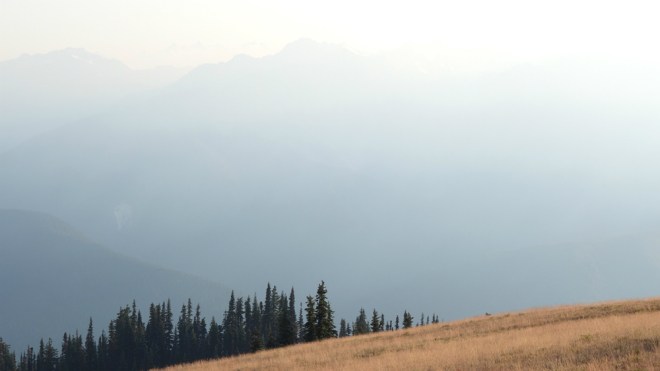
Smoke from Paradise Fire obscures the iconic view of the Olympic Mountains, July 19, 2015. Subhankar Banerjee
The old-growth rainforest that stretches beyond the western valleys of the Olympic National Park is its crown gem. As UNESCO wrote in recognizing the park as a World Heritage Site, information technology includes "the best instance of intact and protected temperate rainforest in the Pacific Northwest." In those river valleys, almanac rainfall is measured not in inches just in anxiety, and information technology's the wettest place in the continental United States. There you will observe living giants: a Sitka spruce more 1,000 years onetime; Douglas fir more than 300 anxiety tall; mountain hemlock at 150 anxiety; yellow cedars that are nearly 12 feet in bore; and a western red cedar whose circumference is more than than 60 feet.
The rainforest is dwelling to innumerable species, most of which remain hidden from sight. Notwithstanding, while walking its trails, you tin can sometimes hear the bugle or get a glimpse of Roosevelt elk amongst moss-draped, fog-shrouded bigleaf maples. (The largest herd of wild elk in North America finds refuge here.) And when you lot exercise, you'll know that you've entered a Tolkienesque landscape. Those elk, by the way, were named in honor of President Theodore Roosevelt who, in 1909, protected 615,000 acres of the peninsula, as Mountain Olympus National Monument.
Why not include a rainforest in a national park? That was the question being asked at the turn of the 20th century and Henry Graves, chief of the U.S. Forest Service, answered it in definitive fashion this way: "It would be great fault to include in parks neat bodies of commercial timber."
Despite the power of the timber industry and the Forest Service, however, five committed citizens with few resource somehow managed to protect the peninsula's final remaining rainforest. "They did it by involving the public," environmentalist and former park ranger Carsten Lien writes in his Olympic Battlefield: Creating and Defending Olympic National Park. He adds, "Preserving the environs through direct citizen activism, as nosotros know it today, had its beginnings in the Olympic National Park battle."
In 1938, the national monument was converted to Olympic National Park and a significant amount of rainforest was included. As Lien would observe in the late 1950s, however, the Park Service, despite its rhetoric of stewardship, continued to let timber interests log there. Today, such practices are long past, though commercial logging continues to play a significant part in the economy of the peninsula in national, state, and individual forests.
A burn that just won't stop
Once the fire began, I just couldn't go along abroad. On a rainy July 10, for instance, listening to James Taylor's Fire and Rain, I drove toward the Queets River Valley to learn more than about the Paradise Fire so that I could "talk about things to come."
At the Kalaloch campground, I asked the first park employee I ran into whether the rain, so coming down harder, might extinguish the fire? "It will slow down the fire'southward spread," she told me, "merely won't put it out. There's also much fuel in that valley."
The adjacent morn, with the rain nevertheless falling steadily and the burn still called-for, I stood at the trailhead to the valley thinking about what another park employee had told me. "The pitiful thing," she said, "is that the fire is burning in the nigh archaic of the three river valleys." In other words, I was standing mere miles away from the devastation of one of the most primeval parts of the woods. As Queets was also one of the more than difficult locations to visit, less attention was beingness given to the fire than if, say, information technology were in the always popular Hoh valley.
In a sense, the Paradise Fire has been burning out of sight of the general public. Data nigh it has been coming from press releases and updates prepared by the National Park Service. Though it is doing a skillful chore of sharing information, environmental disasters and their lessons often sink in most securely when they are observed and absorbed into collective memory via the stories, fears, and hopes of ordinary citizens.
I had breakfast at the Kalaloch Gild restaurant, non far from the Queets,while the rain was however falling. "When will the sun come out?" an elderly woman at the next table asked the waitress as if lodging a complaint with management. "The whole weekend we've been here information technology'due south rained continuously."
"I'thou so happy that finally we got three days of rain," the waitress responded politely. "This year we got 12 inches. Usually we go near 12 feet. It's been bad for trees and all the life in our area." In fact, the peninsula has received over 51 inches of rain, generally last winter, but her point couldn't have been more on target. "It has been so dry that the salmon can't move in the river," she added. Her phonation lit up a fleck every bit she connected, "With this rain, the rivers will rise and the salmon will be able to go upriver to spawn. The salmon will return."
I asked where she was from. "Quinault Nation," she said, citing i of the local native tribes dependent both nutritionally and culturally on those salmon.
"The Queets, the largest river flowing off the w side of the Olympics, is running at less than a third its normal volume," the Seattle Times reported. "[B]ad news for the wild salmon runs, steelhead, bull trout, and cutthroat trout." In addition to the disappearing snowpack and severe drought, the iconic glaciers of the Olympic Mountains are melting rapidly, which volition likely someday spell doom for the park'southward rivers and its vibrant ecology. Co-ordinate to Bill Baccus, a scientist at the park, over the concluding xxx years, those glaciers accept shrunk past about 35 per centum, a straight consequence of the bear on of climate change.
After breakfast, I took off for the Hoh Valley. At its visitor eye, a ranger described the boxing underway with the Paradise Fire. Summing up how dire the situation was, he said, "Our goal is solitude, not containment." Commonly, success in fighting a wildfire is measured past what pct of information technology has been contained, only not with the Paradise. "Prophylactic of the firefighters and safety of the human communities are our 2 priorities correct now," the ranger explained. As a upshot, the National Park Service is letting the burn burn further into wilderness areas unfought, while trying to stop its spread toward human communities and into commercially valuable timberlands outside the park.
For firefighters, combating such a blaze in an old-growth rainforest with steep hills is, at best, an impossibly dangerous business organisation. Big copse are "falling downward regularly," fire fighter Dave Felsen told the Seattle Times. "You tin can hear swell and you endeavor to move, merely it'due south so thick in there that at that place is no escape route if something is coming at you."
Too, many of the traditional means of fighting wildfires don't work against the Paradise. Dumping water from a helicopter, to take 1 example, is about meaningless. As an NPR reporter noted, the rainforest awning "is so dense that very little of the h2o volition make information technology down to the fire burning in the underbrush below." Worse all the same, as the Washington Post reported, the large trees and thick growth "brand it impossible to effectively cut a burn down line" through the leafage to contain the spread of the flames.
With the moist lichens and mosses that usually give the rainforest its magical appearance shriveled and stale out, they at present aid spread the burn from tree to tree. When they burst into flames and fall to the ground, still more of the dry underbrush catches, too. In other words, that woods, which normally would have suppressed a fire, has at present been transformed into a tinderbox.
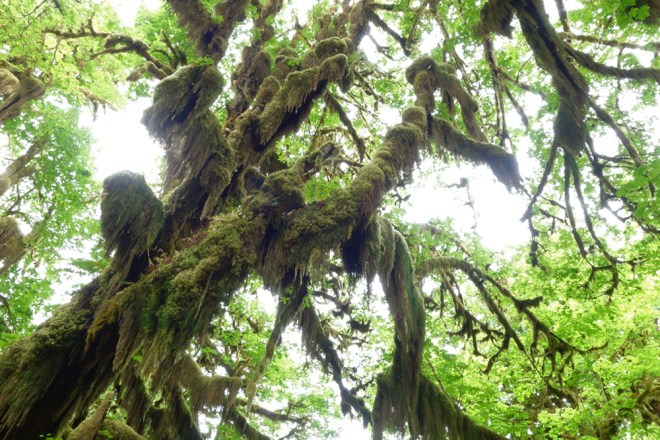
Moss-covered bigleaf maples in the Hoh rainforest, June 2014. Subhankar Banerjee
"Few people in our profession have always seen this kind of burn in this kind of ecosystem," Bill Hahnenberg, the Paradise Burn down incident commander, told his crew. "The information y'all assemble could be actually valuable." He didn't accept to add together the obvious: Its value lies in offering hints as to how to fight such fires in a future that, every bit the region becomes drier and hotter, will exist ever more acquiescent to them.
And then far, the fire is smoldering, but as the summertime heats upwards, the Seattle Timesreports, "there is all the same the potential for a crown burn down that can spread in dramatic mode as treetops are engulfed in flames." According to several park employees I spoke with, the Paradise Fire is likely to burn until the autumn rains return to the western valleys. As of July 23, it had eaten ane,781 acres, which sounds modest compared to other fires burning in the W, but y'all have to remind yourself that information technology'south non minor at all, not in a temperate rainforest. It also poses a claiming to the very American idea of land conservation.
Throughout the tardily 19th and 20th centuries, American environmentalists passionately fought to protect big swaths of public lands and waters. The national parks, monuments, wildlife refuges, and wildernesses they helped to create laid the basis for a new American identity. Nationalism aside, such publicly protected lands and waters too offered refuge for an incredible diversity of species, some of which would have otherwise found information technology hard to survive at the edges of an expanding industrialized, consumerist society. Today, that multifariousness of life within these public lands and waters is increasingly endangered by climate change.
What, then, should environmental conservation wait like in a 21st century in which the Paradise Fire could go something like the norm?
Tankers and rigs
"This is not an anthropogenic fire," the ranger I spoke with at the Hoh visitor center insisted. In the most literal sense, that'due south true. In late May, lightning struck a tree in the Queets Valley and started the fire, which then smoldered and slowly spread across the north bank of the river. It was finally detected in mid-June and firefighters were called in. That such a lightning strike disqualifies the Paradise Burn down from being "anthropogenic" — human-caused — would once have been a given, but in a world beingness heated by the burning of fossil fuels, such definitions take to be reconsidered.
The very rarity of such fires speaks to the anthropogenic nature of the origins of this one. After all, a temperate rainforest as a vast collection of biomass and so a carbon sink is merely possible cheers to the rarity of fire in such a habitat. Co-ordinate to the Globe Wild fauna Fund, "With a unique combination of moderate temperatures and very high rainfall, the climate makes fires extremely rare" in such forests.
The natural fire wheel in these forests is about 500 to 800 years. In other words, once every half-millennium or more this forest may experience a moderate-sized fire. But that'south now changing. Mark Huff, who has been studying wildfires in the park since the late 1970s, told Seattle's public radio station KUOW that in the by half-century in that location take already been "iii pocket-sized-sized fires" here, including the Paradise, though the other ii were less destructive. According to a National Park Service map ("Olympic National Park: Fire History 1896-2006") in the western rainforest, during that century-plus, two lightning-caused fires burned more than 100 acres and another more than 500 acres.
If, still, fires in the rainforest get the new normal, comments Olympic National Park wild fauna biologist Patti Happe, "then we may not accept these forests."
A team of international climate change and rainforest experts published a study earlier this year warning that, "without drastic and firsthand cuts to greenhouse gas emissions and new wood protections, the globe's most expansive stretch of temperate rainforests from Alaska to the coast redwoods will feel irreparable losses." In fact, says the study's lead author, Dominick DellaSala, "In the Pacific Northwest … the climate may no longer support rainforest communities."
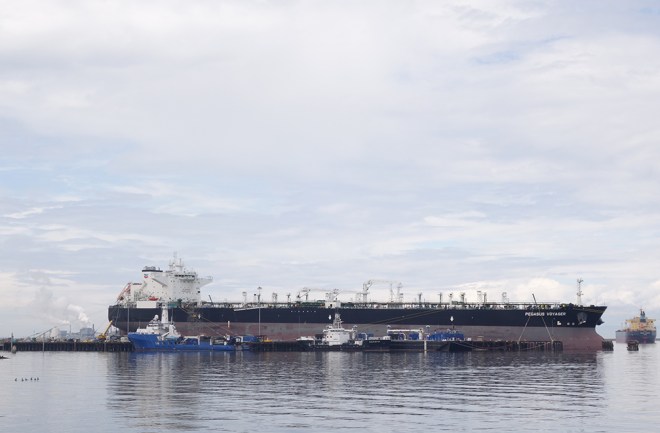
The Chevron oil tanker Pegasus Voyager moored in Port Angeles Harbor (with Geese), July 2015. Subhankar Banerjee
Speaking of the anthropogenic, on our way back, Finis and I stopped in Port Angeles, the largest city on the peninsula. At that place we noted a Chevron oil tanker, the massive 904-foot Pegasus Voyager, moored in its harbor on the Salish Body of water. It had arrived empty for "topside repair." Today, only a small-scale number of oil tankers and barges come here for repair, refueling, and other services, but that could change dramatically if Canada'south tar sands extraction projection really takes off and vast quantities of that specially carbon-dirty energy product are exported to Asia.
That manufacture is already fighting to build two new pipelines from Alberta, the source of nigh of the land'south tar sands, to the coast of British Columbia. "Once this invasion of tar sands oil reaches the coast," a Natural Resource Defence force Quango press release states, "up to two,000 boosted barges and tankers would exist needed to bear the rough to Washington and California ports and international markets across the Pacific." All of those barges and tankers would be moving through the Salish Sea and forth Washington's coast.
And permit's not forget that, in May, Trounce Oil moored in Seattle's harbor thePolar Pioneer, one of the two rigs the visitor plans to use this summer for exploratory drilling in the Chukchi Body of water of Arctic Alaska (a project but recently green-lighted by the Obama assistants). In fact, Shell expects to use that harbor as the staging expanse for its Arctic drilling fleet. The arrival ofPolar Pioneer inspired a "kayaktivist" campaign, which received national and international media coverage. Information technology focused on drawing attention to the dangers of drilling in the melting Arctic Ocean, including the meaning contribution such new free energy extraction projects could make to climate change.
In other words, two of the nearly potentially climate-destroying fossil-fuel-extraction projects on Earth more or less bookend the burning Olympic Peninsula.
The harbors of Washington, a state that prides itself on its environmental stewardship, have already become a support base for i, and the other will likely join the oversupply in the years to come up. Washington'due south residents will gradually become more than accustomed to oil rigs and tankers and trains, while its rainforests burn in yet more paradisical fires.
In the meantime, the Olympic Peninsula is notwithstanding wreathed in fume, the West is still drought central, and anthropogenic is a word all of u.s. had ameliorate acquire soon.
Source: https://grist.org/climate-energy/what-happens-when-a-rainforest-burns/
0 Response to "what happens to soil when rainforest is cut down"
Post a Comment